Leadership and Tithing

Image
Letting people know your vision as a leader is vital as a pastor as people give to vision. At Tree of Life, we want people to understand God and His nature and His principles, and how to live by faith in every single area of their life and finances is no exception. It would be hard to be at the Tree of Life for any length of time and not understand the principles of tithing and sowing and reaping. As a result, people in our church are getting promotions and new jobs all the time – finances are coming to them in abundance.

But we are still not at the place where I want to be, and that is at the place to bless London. And to progress in wealth increase, understanding must increase. People must understand what money has to do with the kingdom of God or people will not give and then they will not receive. If you don’t know something – you can’t walk in it. That’s why people are destroyed through lack of knowledge. I know pastors who are scared of talking about money, but if the shepherds of the sheep don’t talk about money and the prophets of God don’t talk about money, then people will only ever understand prosperity from a carnal, worldly point of view and that will never help them!

I would never want to be someone who did not teach the importance of the tithe. James 3.1 says teachers will be judged more strictly – because as a teacher of God’s Word you are not just judged on your lifestyle and your investment in the kingdom, but you are judged on what you taught the church. I would never want to be in a position where I am judged for failing to teach people the truth about tithing and how giving in faith is the single most important key to financial freedom. Paul taught the Corinthians and the Galatians about sowing and reaping, and in Hebrew’s he said that:

And here men that die receive tithes; but there he receiveth them, of whom it is witnessed that he liveth (Hebrews 7.8)

So, here on earth you tithe to a human being – a ministry, a church, a para-church organization – but something that is human. But as you take your tithe and give it to the local church and the leadership of the local church, in heaven, that money is presented straight to Jesus. That is an awesome truth. and one that people need to know. When you tithe, that gift is part of your worship, part of your sacrifice of praise to the Lord Jesus Christ!

So when you tithe, realize that your money is not just going to an earthly organization – it is reaching Jesus. Jesus receives tithes today. Worship the Lord through your giving.

And with the tithe, the local church then pays for pastors to love you, and shepherd you and teach you, it pays for training for musicians to lead worship, for children’s pastors to train your children in a godly way, for meetings and special speakers who bring you truth and freedom.

The tithe is doubly amazing as it produces fruit on two levels; the heavenly level and the earthly level.

To bless London as a church is more than just a gimmickly slogan with us, it’s what we genuinely want to do, it’s the life we want to life. We want London to be a better place because Tree of Life is there. Tithing is one of the ways we can lift people’s lives: we can encounter Jesus as He receives our tithe, and we can spend the money on earth to impact the city. Tithing is one of the keys to impacting a city with the love of God.

In Abraham’s life, tithing was a step of faith. In the Old Testament it became a mandatory law. Now in the New Covenant, it is back to being a privilege, a step of faith in God’s goodness and graciousness. Tithing is a step of faith which says that I believe God is first with my money, I believe God is the most important source in my life, I believe that God is first. If the church cannot make Him first with money then the city will never be challenged or inspired to make Him first in anything.

The tithe also is a step of honour and gratitude. By taking 10% of our income and giving it to Jesus, we are showing beyond the shadow of a doubt that we are grateful for the other 90%! Never pressurize someone to tithe, but do teach the Word and do press people to make a decision to honour God with their finances.

Finally, giving 10% does not mean you can then afford to be a poor steward with the other 90%. Some people think: right, I have paid God off now I will spend the rest on me how I want. Don’t be that person – ask God for wisdom and boldness with the other 90%, the way He leads may surprise you but I bet you end up better off living off of God’s wisdom than living off of your own!


Three Things I Will Never Do

The hardest leadership lessons are lessons learned the hard way.  If you have been in leadership of people more than a year or so, you will have made mistakes.  That’s just a fact.  The worst mistakes are the ones we know we could have avoided – good advisors, wise mentors, experienced experts told us not to do a certain thing, and due to our zeal, our youthfulness, our inexperience – and let’s face it, our arrogance – we did it anyway, thinking we would be the exception to the rule.  And we weren’t. 

I’ve learned a few things this way – through difficult experience rather than through the wisdom of others.  And the truth is while it is not the most efficient and most useful way to learn, lessons learned through experience never leave you, and leave the deepest convictions in your soul.  As such, there are three things I will never do, because I have learned the hard way.  I am not going to share too much details about the situations, but just share the fact that these convictions stem out of difficult mistakes I made and had to face head on. 

THREE THINGS I WILL NEVER DO

3. I will never appoint an elder whose spouse is not happy with that appointment.  I was advised not to, a very wise mentor and friend, and one of the most experienced church planters and leaders I know told me not to.  But I did.  And it almost split the church in two.  All the warning signs were there, but in my zeal I ignored them.  But through that experience, I am now very cautious in appointing leaders.  Of course, you will never find the perfect leader – but if their own husband or wife are not happy with them taking the role, and you appoint them, you are asking for trouble.  That’s just a fact!

2. I will never permit someone to preach who doesn’t respect my vision and the vision of Tree of Life Church.  That’s just a fact – you cannot let someone into your pulpit who thinks you are doing something wrong by planting the church and holding the church.  This goes for worship leaders as well.  You are better off with a CD player or MP3 player than having a worship leader – no matter how talented – who doesn’t believe in your vision.  I have let people lead worship and preach to encourage them, because live worship is important to me and my values, to help raise a crowd.  All of it is in vain if the person disagrees with the vision.  That disagreement will come out from their leading and their being at the front, and you can’t argue with it that well with others because you put them in the front.  I’ve learned this the hard way, and I am never making that mistake again.

1. I will never compromise what I believe to satiate a carnal request.  A lot of Christians are carnal.  They make their decisions purely based on the flesh.  One lady came to us in the early days and told us our opening declarations were witchcraft.  I knew they weren’t, but I seriously considered stopping them just to make her more comfortable in the church.  Now there is nothing wrong with changing things in a church to make people feel more comfortable – but the declarations are a core part of our vision and values as a church.  I never did stop them and the lady left, but I have hundreds of testimonies of people who have been healed, delivered, encouraged, inspired due to those declarations.  Some times you just got to do what you got to do.

No Regrets

Image

Of course, no matter what you or I have ever done there is goodness and mercy following us all the days of our lives.  But the truth is that the easiest way of living a life without regrets is not to actually do anything you regret.  Thom Rainer did a survey of pastors in America and asked them the simple question what do you regret most during your time pastoring.  These are the top seven answers:

  1. Said or wrote something out of anger. 
  2. Obsessed with one or a few critics. 
  3. Failed to admit a mistake. 
  4. Neglected a family member for a church need. 
  5. Pushed an initiative rather than getting buy-in.
  6. Left a church too soon. 
  7. Focused on/obsessed over another church in the community

If you are new to church leadership or have been pastoring for years, just take the time to read this list slowly, contemplatively, prayerfully.  Consider where you are vulnerable.  Consider where you might – if you don’t change the train you are on – have regrets where you end up.  Do you have a temper?  Do you obsess about the one person who moans rather than the people who were saved, healed, encouraged, inspired and challenged?  Do you fail to be honest with someone?  Have you ever put church above family?  Ever acted in a way as to get there first rather than bring as many people with as possible?  Ever quit when you shouldn’t have quit?  Ever thought more about a church where you don’t go, don’t worship, don’t lead, don’t serve too much?  

If so, time to renew your mind, transform your life and minister and pastor.  No regrets.  Nip it in the bud before it grows all over your garden.

5 Things That Will Make You A Better Preacher

Image

In 1 Samuel 13.19, we find out that when the Philistines conquered and enslaved Israel they took out all the blacksmiths so there was no one around who could make weapons so that people could fight and win and re-gain their freedom.  Today, the church is in a similar position – very few preachers are actually equipping the church to fight, to beat sickness, to win against poverty, to conquer a poor self-image, to defeat discouragement and despair.  Most Christians are still tossed to and fro by every wind of doctrine because they have never been equipped to stand.

Now a lot of that can be the individual’s fault – people who don’t go to church, or who go once a month, they will never be in a position to be equipped, and that destructive doctrine that we can live the Christian life on our own without a local church is still doing the rounds sadly.  But as a preacher, you can take steps to make sure that your preaching is equipping people to do the works of ministry.

1. Preach What You Know

You have a wealth of knowledge – sicknesses you have defeated, attitudes you have laid down.  For the Word to be effective it has to become flesh – let people see how the Word has become flesh in your life.  Share your victories, share your learning curve.  Let people see that you are moving forward and growing in grace!

2. Make it practical

You have to preach the Word, but you also have to interpret the Word and apply the Word.  So for example, you could preach on 1 Cor. 13 and preach that “Love is patient”.  That’s the Word.  Now tell people what it means: patient means steadfast under pressure, so when you love someone you put up with pressure and you are still the same.  Then you apply it: so, in your marriage, don’t snap at your wife when she has a bad day, show love and be the same – be patient, be steadfast.  Let your people know what the Word means and what it means for them.

3. Give Your Message A Title

The title clarifies the thought.  Spurgeon said he would rather nail a 10 inch nail into someone, rather than throw a box of thumbtacks at them.  That’s true – your message needs to be one clear point.  Giving your message a title helps you focus on what you are saying.

4. Prepare, prepare, prepare

Don’t just expect to walk in the pulpit and share and be a success.  Prepare: study the Scriptures you are going to use, meditate on them, plan what you are going to say, consider and pray about what personal illustrations to use, on what other illustrations to use.  Consider carefully the interpretation and application of the Word of God.

5. Start Well

Start by introducing the topic you are preaching on and let people know why it is important.  That will mean that you are engaging them from the start.

8 Keys to Raising Leaders without a Potential Coup

Image

Sadly many churches have experienced splits due to a coup.  A coup is where a group of people take authority that was never theirs in the first place.  Some pastors are so afraid of this kind of thing they never raise leaders, hate small groups and centralize everything and control everything!  That is not the approach.  Your mandate as a pastor is to bear fruit and equip the saints to do the work of ministry!  If you are the lead pastor of a church, here are 4 keys to ensuring you don’t have a coup that don’t involve never raising leaders, and don’t involve being controlling!

  1. Let everyone know that you are in charge, and more importantly, know that you are in charge yourself.  The sad truth is that there are many people looking to take advantage of weak leadership, and possibly more so in the church than anywhere.  Assistant pastors will dominate you, deacons will capitalize on your lack of self-confidence, and elders will happily make all the decision for you.  You need to be like Paul who was happy to say “Paul, an apostle…” – you need to be certain in your calling.  You may be raising leaders, but that doesn’t diminish your leadership in the church and you are not raising them to lead you!  Know that you are not in charge of people’s private lives, but you are the visionary in charge of the direction the church is going.
  2. Let people know they are very important, precious even.  But never let anyone be deluded into thinking they are indispensable. Let people know that you are not afraid of them or any threat they may make.  They need to realize that they are honoured to be at your side, and must keep their rank by not exceeding their boundaries.  Your associates should never feel that they are the ones holding the church together!  Some people will try and control you by letting you think that they will tear the whole ministry apart – they should not be in power in your church!  People who see themselves as an equal head with you are dangerous!  Two headed creatures are freaks of nature, not healthy creatures!  
  3. Make the Dream Plain.  Everyone should know where you are going and why.  Everyone should know that you are building what you are building and what the blueprint is.  If you are building a mega-church, let people know upfront that is the plan and why the plan is so important.  The clearer the dream the easier it is to walk together.  When the dream is not plain, when the vision is secret, when the direction is not made plain, people will tire of following you and when someone turns up with an easier plan they will follow them.  Imagine trying to move a wardrobe with three other people but no-one is sure why or where exactly you are taking it – that is most churches and you will soon put your corner down and do something else unless someone is showing you the way forward and the reason for the move.
  4. Tell people what you expect from them.  The head is not respected when people have undefined roles in the church.  Let your leaders know what you want them to do.  Let your people know what you are up to, and what you want them to be up to.  Make sure everyone knows their place.  Don’t let people take charge of other things just because you put them in charge of one thing.  If people do not have specific duties, then there is zero way of making people accountable. 
  5. Praise all your leaders publicly as often as you can.  Public praise is the easiest way to ensure the repetition of good behaviour.  It also creates a culture of loyalty.
  6. Never correct your leaders publicly.  It is difficult to lead others when you have been told off in front of them.  I have never let a boss do that to me, although in both retail and education, some have wanted to.  It is a bad practice, and should never be done.  Public criticism is very degrading.  Make sure your criticism is constructive, not destructive, and deliver it one on one.
  7. Take responsibility.  Don’t be Adam – it was the wife.  Or Saul – it was the people.  You are the head.  If someone messes up on your watch, it’s your watch so take ownership of the mess and get it tidied and make it right with the people who were hurt.  If you want the honour of being the senior pastor, you MUST accept the blame!
  8. Realize your leaders are the most important people in your church.  Don’t blow out an appointment with them for Mrs Smith and her thousand problems which she simply must share!  Your leaders will make or break your ministry.

In order to bear much fruit, you have to raise leaders.  You do not have to do it at the expense of your dream and your ministry. These steps will help you lead your team well.

5 Reasons Some People Never Enter Ministry

closed door


1.  They aren’t prepared to take a chance and a risk.

2. They are lazy.

3. They aren’t prepared to start small.

4. They aren’t prepared to start in a ministry with someone else’s name on the door.

5. They aren’t prepared to help people for free

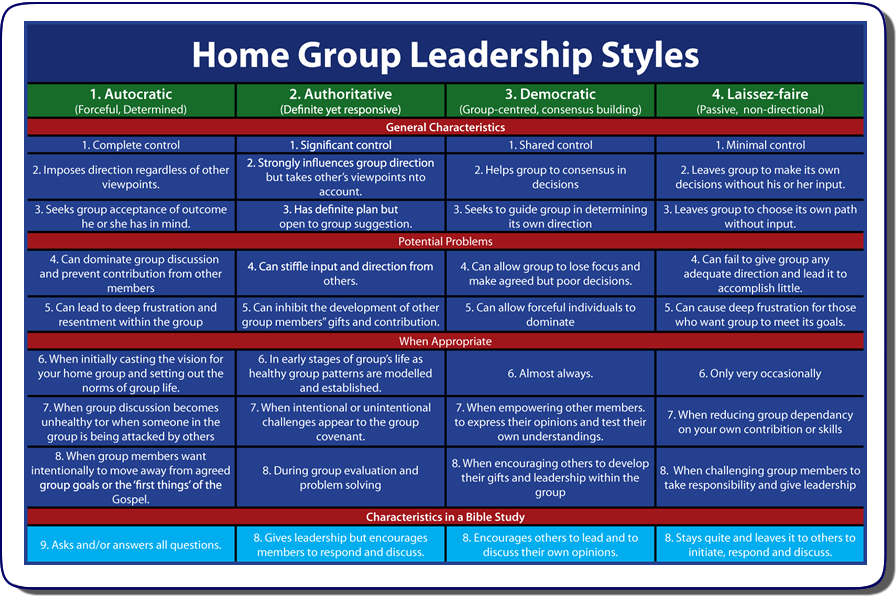
Differing Styles of Home Group Leaders

HG-LeadershipStyles

Your home group leaders will have different styles due to their differing backgrounds, ages, styles and personalities. That’s not a problem. What is a problem is when they don’t know when a slightly different approach is necessary. This chart shows the differing styles and when they are important. It should help any small group leader consider their style. Remember – anything done on purpose is better!

The Three Rungs of Successful Leadership

Just being a pastor, or being the boss does not make you a leader.  Being a leader simply means having followers – now that doesn’t mean you are the next Jim Jones and people follow you blindly – it is much more mundane, but also much more amazing than that.  Being a leader simply means you influence people on purpose.  We all influence people – we make people think and act in certain ways that they wouldn’t if we weren’t about.  For some people that influence is accidental, we are moody and grumpy and go to work and make the whole place moody and grumpy.  We are offended at an elder in the church, so we go to church and gossip and affect the behaviour of the church and corrupt the place.

But leaders – and everyone is called to be a leader – influence people for the better.  They reckon the shyest person on planet earth still will influence over 10,000 people in his lifetime, and the average person influences a dozen people a day.  You influence your children, your friends, everyone.  Leadership is just becoming better at influencing people.  So let’s find out about leadership and how to climb the three rungs of leadership.

The first rung is called RELATE.  You have to get to know people.  You have to build relationships, you have to find out about people. There’s an old saying: people don’t care how much you know until they know how much you care, and it is true.  You need to care about people.  If you relate to people, they will love you!  People are lonely in this world, and we are not designed to be alone.  If you are the boss, go for a walk around the office and ask how people are doing, find out how their children are doing, find out what they enjoy, what they like doing outside the office.  Go and make some friends – let people know you care.  That’s the first rung and if you get it right, people will like you!  If you are unable to build healthy relationships, you will never be able to lead long-term – that’s a fact!  To be great at this rung, have a genuine love for people.  Care about the success of the people you work with.  Make sure people are more important than procedures.

The second rung is called RESULTS.  You have to be someone people can respect to get the job done.  If you are the manager at work, get your department making some money!  If you are the pastor, get the church doing something God honouring that attracts new people to the service.  On the first rung (RELATE), you get together because you get together.  But good leadership then takes the next step to RESULTS and gets together for a purpose.  You need to become results-orientated to become a good leader.  In certain fields (football and sales, for example) it’s obvious what makes a good result.  In other fields (church life for example!) you need to also clarify what a good result is and celebrate it.  For example in our church, we are about making disciples who dream big. So when one of our guys met a couple in the car park who were going to a miracle service and prayed for them and got them healed before they ever got to the miracle service, we celebrate and tell that story because we are celebrating the win.  When people get born again, or we have record attendance, or new people get released into leadership, we clarify to people: look a win.  That helps them know you are getting results.  At this rung, people respect you.

To do well at this rung, do things that cause growth – use some initiative.  Have a dream, scheme and theme for your business, church, organization.  Develop a system of accountability for results – including your own!  

The third and final rung is called REPRODUCE.  This is when you start to succeed as a leader – a great leader isn’t great because he is great, he is great because the people he leads are consistently great.  You invest yourselves in the life of others and you reproduce success and life in them.  People come to your church and they have no or little social skills, and you bear with them and help them develop social skills.  That is reproduction.  You are a great preacher and you break down the process of preaching so that some around you become great preachers.  That is reproduction.  If you step onto this top rung, people will be loyal to you naturally because they know they owe you part of their life because you poured it into them.  At this stage you become a leader of leaders and are now helping others climb these three rungs to leadership.  As you do, never forget the lessons from the first two stages: don’t suddenly become aloof and let success insulate you from the people who you should be relating too.  Spend some time reading the annual reviews of your entire team.  Read all the connection cards yourself, and email a personal response to everyone.

To be valuable on this final rung, realize that people genuinely are your most important asset.  When I started church planting I thought money would be the scarest commodity – but it’s not, it’s good people.  Be a model for others, help your key leaders grow and surround yourself with an inner core of people that complement your giftings and who love leadership and love your dream.

Remember to still get results, but now you get results as a team, not just as a one-man band.  The higher you climb this little three runged ladder of leadership, the easier it is to lead.  The greater the growth of your business, church, department.  But never leave the RELATE step behind!

Now if you are leading a group, you may not be on the same rung with everyone, and that’s fine, but take the time to climb up! Become a better leader!  And for your leadership to be truly effective you must take people up to the third rung with you and show them how to get RESULTS and REPRODUCE.–

Role of the Pastor 7: Releasing

Image

God designed the universe to work in order, and everything God has ever designed and built works in an order and produces after its own kind.  Trees produces trees, cats give birth to cats, dogs give birth to dogs, and horses give birth to horses.

Pastors should be giving birth to pastors!  That means two things: firstly, you should be raising up people in the church who end up being pastors – they are appointed in the body of Christ by Jesus to be part of the pastor ministry as outlined in Ephesians 4.  That’s why good pastors don’t just pastor, they are always looking at planting churches because they are raising up pastors!  

Secondly, it means that the attitude of the pastor should be infectious among the church.  All the good shepherd things – preparing food for the sheep, caring for the sheep, going after the lost sheep – should be part and parcel of the attitude and culture of people in the whole church.  

The idea that the pastor is a lone wolf who does everything couldn’t be further from the Biblical model.  I believe it has been adopted because a lot of pastors in ministry today have never been called by God to be pastors, are not able to bear pastoral-fruit because they are not a pastoral-tree in the first place!  But those who are called by Christ to be pastors should easily bear fruit and that fruit should be pastoral fruit.

Now this process of raising up pastors and leaders within the church is a three step process:

  • Flow
  • Identify
  • Release

Flow simply means to flow in your gifting and calling.  If you are a pastor, pastor.  Bearing fruit is not hard if you are a tree – it’s natural. If you are called to pastor, it’s natural to bear fruit.  Just do what you are called to do.

Secondly, as you go, identify those around you who are called.  This process can be very supernatural, or very natural.  Sometimes God will be very specific and clear about who is to be your assistant pastor, your community pastor, etc.  Other times it is like Acts 15 “it seemed right to the Holy Spirit and us” – the person is just the right fit, and you don’t need a voice from heaven to know that person is part of your church.

When identifying people, don’t just look for gifts.  Gifts are not enough.  A qualified person for you to raise up must have the following three qualities: they must have a gifting, they must have character, and they must have your culture.  Some people are really gifted but have no character – they will destroy your church.  Destroy it.  Do not raise up people who are not focussed on improving and developing their character.  Don’t appoint greedy people, people who are selfishly ambitious or people who cannot relate to the opposite sex with respect and purity.  That will kill your church.  Other people are gifted and have character but don’t get your culture – people like that – even with the best intentions – will split your church.  It’s slightly better than getting destroyed, but it’s still painful.

Your culture might be really into small groups – if so, don’t raise up people who don’t get small groups.  If your culture is multi-ethnic, watch people relate to those from all sorts of backgrounds before appointing.

Then the final stage is to release.  This is not a once and for all – it’s about steps.  As the church grows, your responsibilities and task will grow, and other people’s jobs will grow.  So you need to release people step by step.  Get them to receive an offering before you ask them to preach.  Get them to put out chairs before they receive an offering.  If they are too big for putting out chairs, there is a massive clue there! If they can’t usher but only want the upfront job, or the job with prestige, you know something!

But those people who are willing to work, release.  Some pastors hold tightly to everything – and I get it – you should be a control freak – you have built that church with God’s grace and your blood, sweat and tears, and you should not let someone who has invested a lot less, and will be fine if the church falls apart, turn the church into their personal ministry pool.  That’s all true.  But you can stay in control of the vision, but release control of the elements of the church and raise up others.  Others who will do things differently, others who may betray you and may stab you in the back.  Jesus knew Judas would betray him, but he still delegated and released the twelve.  I found over time that Jesus’ ratio of 12 apostles:1 money hungry, power crazed, ego driven, back stabbing Judas is about right.  People will hurt you, but others will help you.  And the help outweighs the hurt, and the world is too large for another one-man band church – so you must look beyond your insecurities and hurt and release people into ministry.

Then as they are released, continue to supervise.  Continue to advise.  Continue to push out of their comfort zone.  They can preach – but can they give an altar call, can they preach in series?  They can tidy the cupboard after church, but can they train someone else to do it?  They can sing in the choir, but can they lead worship?  Always flow, identity and release – it’s part of the role of a pastor.


Role of the Pastor 6: Training

Part of your role is training the sheep.  You will be loved for feeding them, and hated for training them.  You are responsible for training the sheep to embrace and understand the culture of your church, how to behave at church, and how to live the Christian life.  The worst pastors are the pastors that let anything go – their churches are not safe places to be.  Things will get out of line if you just leave them to their own devices.  That is a fact!

Paul asked the Christians in Corinth this pertinent question: “Shall I come unto you with a rod, or in love, and in the spirit of meekness?” (2 Cor. 4.21).  Most of the time you come to the sheep in love and with meekness, but there are times you have to lay down the law.

You have to purge certain tendencies and ideas out of your church.  If your sheep think you are a weak leader, then you will be exploited by your church, and taken for a ride more than once.

Many years ago, I was at a church once where the pastor called a young man to the front of the church.  It was a mid-week meeting, and I didn’t really know the church.  I thought they were going to honour the guy in some way, and to be honest, the guy looked like he did too.  But the pastor said “This young man is a thief and a liar, he has conned several people in the church by doing this and that.  Look at him, and do not be conned by him.  He has seduced several ladies in the church and blackmailed them and stolen from them.”  I was stunned, but the church applauded – they knew people that had been hurt by this man, and who had lost property to his con.  There as a young man, I learned the power of strong leadership to protect the sheep. You cannot let people come to your church and just do whatever they want. 

I was once physically removing a young man from a youth meeting for continually making sexually offensive comments to the young ladies, I was the youth pastor in that church.  The senior pastor saw me doing it and told me to be a bit more gentle.  When I explained what the young man had done, the senior pastor told me to be a little more rough!

1 Cor. 5.6-7 is clear: Know ye not that a little leaven leaventh the whole lump?  Purge out therefore the old leaven.  This is so important – people will corrupt people.  Negative, whining, complaining people will infect people.  You need to train your people to reject gossip and reject whining, and reject negativity.  

To some people in your church you need to be strong, and tell them that their behaviour was disappointing, was destructive, that was not healthy behaviour.  You need to have a statement of culture that you can refer to and let people know “this is not how we do things around here”.  In doing this, you do not humiliate people.  You don’t tell people off in public unless their behaviour is destructive and they have been warned privately several times (as happened in both above illustrations) – you don’t humiliate people.  Sometimes you have to be hard with people, but you never have to be harsh.

“Cast out the scorner, and contention shall go out, yea, strife and reproach shall cease” (Proverbs 22.10).  Sometimes you have to correct people right out the church.  But when you do, strife and reproach stop and it is the greatest feeling on the planet.  Some people just need to leave the church, their presence is nothing but disruptive and unhelpful.  It is that simple sometimes!

But for most people, training is a much more positive experience.  Correction is one side of training, but discipleship is the other side. Three things your church should have to help train people:

1. An obvious path of training.

2. An obvious place of training.

3. An obvious reward to training.

An obvious path to training means that let’s say someone gets saved in your church, or comes from another church, they should know immediately what to do if they want to be discipled.  For us in the Tree, it’s join a small group.  We also have a 5 week course called Vision and Values where we explain our vision and values to people and that ends with us making sure that we open to door for people to be discipled.  For me, the three main areas of discipleship for new Christians or Christians that aren’t growing are: how to read the Bible yourself, how to flow in the gifts of the Spirit and how to relate to a local church – so we do training on all of that.  The courses are offered as often as we can – ideally I’d like to offer them about twice as much as we do, but that’s ongoing development of the church.

An obvious place of training is that people know where they can go if they need help.  Again at the Tree that’s our small groups – the Living Churches.  You go there and you are trained, and taught the Word and encouraged.  You can receive prayer if you need and you will grow.  Any problems and the elder running the group can help or get help.

Finally rewards for training – people like to be noticed and acknowledged, so we celebrate training, we have a pathway for becoming an elder and we have a way into serving and helping and significance in the church.  People need to feel that they are growing.

Keep a strong handle on the church, and make sure that you are making disciples.